

Imagine walking into the office on a Monday morning. Your phone is ringing, and urgent emails from your primary steel supplier fill your inbox. They have placed a strict credit hold on your account—all because a three-week-old invoice is sitting physically on an executive’s desk waiting for a signature.
For many Accounting Managers, this nightmare is an everyday reality. Relying on paper-based workflows for Accounts Payable (AP) and Bill of Lading (BOL) processing creates invisible bottlenecks. While teams waste hours on manual data entry, vendors grow impatient, late fees accumulate, and communication breaks down.
Modern supply chain stability relies entirely on financial velocity. Continuing to use paper-based AP workflows is no longer just an operational inefficiency; it actively destroys vendor trust, throttles cash flow, and threatens business survival. This post explores the true downstream cost of processing delays, unmasks the domino effect that halts warehouse production, and outlines how seamless ERP-integrated automation transforms AP into a strategic asset.
1. The Invisible Cost of the Paper Trail: Beyond Late Fees
Manual invoice routing does more than cost you $50 in late fees; it drains internal resources and strips your organization of financial agility.
1.1 The Manual Routing Bottleneck In manual workflows, invoices routinely get lost in physical trays, cluttered email threads, or mismatched purchase orders. Without a centralized digital intake hub, visibility is blocked. Accounting teams are forced to act as internal detectives, wasting hours chasing down department heads to reconstruct basic audit trails.
1.2 Wasted Hours vs. Strategic Financial Management Every minute spent typing data from paper to screens is time stolen from high-value financial management. Instead of manual entry, your team could be analyzing cash flow trends or negotiating early payment discounts.
According to industry studies by Ardent Partners and IOFM (2023), processing a single paper invoice can cost upwards of $12 to $15, compared to less than $2 for automated invoices. Across hundreds of monthly bills, this financial drain adds up rapidly.
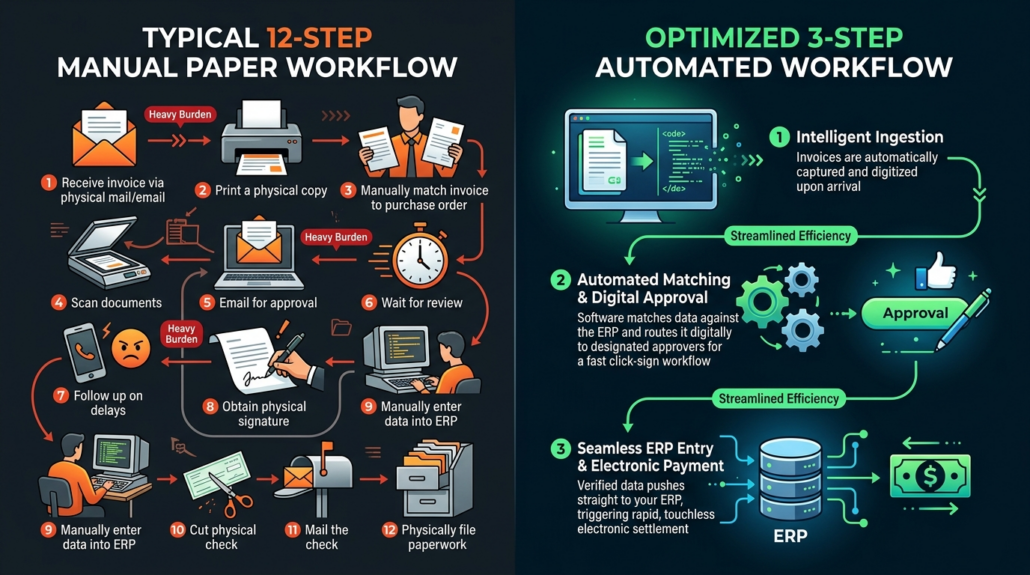
1.3 Visualizing the Operational Friction The difference between an enterprise choked by bureaucracy and one optimized for speed comes down to human touchpoints.
2. The Domino Effect: How Slow AP Halts the Warehouse Floor
Accounting delays do not stay contained within the finance department. A bottleneck in AP quickly cascades into sales order processing and warehouse operations. Learn more here.
2.1 Credit Holds and Frozen Supply Chains A delayed payment triggers an automatic credit hold from vendors, halting raw material shipments. A manufacturer can easily miss major production deadlines because delayed BOL processing caused a massive backlog of inbound freight.
2.2 Lagging Sales Orders and the Picking/Packing Crisis When document queues back up, warehouse teams cannot pack or ship effectively. This leads to late customer deliveries and crippled cash flow. Real-time document visibility ensures purchasing, AP, and the warehouse operate on a single source of truth. If your vendor isn’t paid on time, your warehouse isn’t moving on time.
3. Addressing the Counterargument: “But Our Vendors Are Loyal”
A common justification for delaying automation is the belief that long-standing vendor relationships can withstand manual inefficiencies. In a volatile economy, this is a dangerous assumption.
3.1 The Myth of Supplier Patience Vendors face their own cash flow pressures. They prioritize buyers who offer predictable, transparent payment cycles over those stuck in paper delays. Vendor patience disappears when payment unpredictability threatens their stability.
3.2 Leveraging Fast Payments for Better Pricing Companies using automated, paperless workflows can leverage early payment discounts (e.g., 2/10 Net 30), securing better margins and priority inventory over competitors stuck in paper processes. Automating AP shifts it from a back-office utility to a front-line vendor relationship tool.
4. The Path to Paperless: Unlocking Value via Smart ERP Integration
Transitioning to a paperless workflow doesn’t mean tearing down your existing infrastructure. True efficiency comes from enhancing your current software investments.
4.1 Overcoming “Implementation Dread” Accounting leaders often suffer from implementation dread—the fear of a disruptive software rollout that worsens processing delays.
4.2 The Mosaic Advantage Mosaic Corp. eliminates this risk. Mosaic’s experts integrate document automation directly into your existing ERP and surrounding systems, enhancing system value without disrupting daily operations. Mosaic specializes in bridging the gap between old habits and optimized methods, ensuring smooth cultural adoption.
4.3 Digitized Approvals and Preserved Cash Flow The ultimate result? Instant approval workflows, zero lost documents, optimized cash flow, and vendor relationships built on radical transparency.
Conclusion
Processing delays are not just an administrative headache; they actively erode vendor trust, stall warehouse production, and lock up vital cash flow. Relying on paper in a digital economy creates operational debt your business can no longer afford. Transitioning to a paperless workflow is a baseline requirement for protecting your supply chain today.
Stop letting paper processes dictate your vendor relationships. Download our free checklist, The Paperless Transition Roadmap for Accounting Leaders, or schedule a brief consultation with a Mosaic implementation expert today to see how we can seamlessly automate your AP workflow within your existing ERP.