
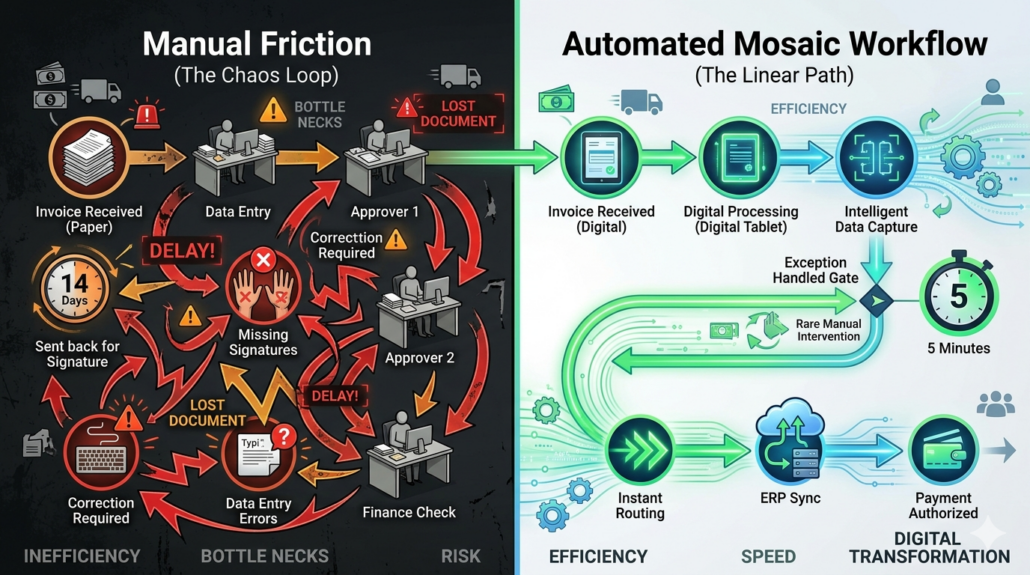
A single sales order delay is a silent operational bottleneck, freezing cash flow and creating drag. Millions of organizations still rely on paper-based workflows, overlooking the compounding negative impact these delays have on their entire ecosystem. Document automation’s true value is its cross-departmental acceleration effect—shrinking processing from days to minutes to unlock trapped cash and eliminate supply chain friction.
1. The Financial Velocity Multiplier: Revolutionizing Accounts Payable
From Processing Penalties to Early-Payment Profits
The traditional manual accounts payable (AP) cycle is grueling. Between manual data entry, routing physical folders, and chasing managers for signatures, it takes organizations an average of 14 days to process one invoice. This strips away financial agility.
Contrast that with a 5-minute automated workflow. According to Ardent Partners’ 2023 State of ePayables report, automated AP workflows reduce the total cost per invoice by up to 80% while cutting processing time by 70%.
The Cost Shift: Manual invoice processing typically costs businesses $12 to $15 per document. High-functioning automated systems drive that cost down to $2.50 to $3.00, representing a massive bottom-line recovery.
Shifting from reactive to proactive cash management allows businesses to capture early-payment discounts instead of letting capital leak through late fees. When processing moves at digital speed, leaders gain total visibility. If you are curious what your current workflow is hiding, consider these 50 questions paper processes cannot answer that your CFO is already asking.
Eliminating the Internal Friction of Approvals
The real damage in AP happens during the waiting game. Automated routing and digital signatures remove the desk-to-desk stagnation that paralyzes purchasing. Automated systems instantly route digitized paperwork based on pre-defined business rules, ensuring compliance without sacrificing speed.
2. Unclogging the Supply Chain: Sales Orders and BOL Processing
Eradicating Warehouse and Picking Lag
Front-office administration and back-office warehouse operations are deeply linked. When sales orders take days to process, picking crews sit idle and shipping schedules fall apart. The warehouse cannot ship what the system hasn’t cleared.
Modern manufacturing organizations utilize advanced automated extraction to process orders in mere minutes. This allows warehouse teams to receive accurate picking tickets and pack items on the same day.
Redefining the Bill of Lading (BOL) Lifecycle
Eradicating Warehouse and Picking Lag
Front-office administration and back-office warehouse operations are deeply linked. When sales orders take days to process, picking crews sit idle and shipping schedules fall apart. The warehouse cannot ship what the system hasn’t cleared.
Modern manufacturing organizations utilize advanced automated extraction to process orders in mere minutes. This allows warehouse teams to receive accurate picking tickets and pack items on the same day.
Redefining the Bill of Lading (BOL) Lifecycle
Logistics velocity is dependent on data velocity. Delays or manual entry errors during BOL processing lead directly to driver frustration and costly detention fees at the loading dock.
The Cost of Waiting: Industry standards show that truck detention fees typically range from $50 to $100 per hour after the initial free period. If your paperwork moves slower than your trucks, your business is actively losing money.
Digitizing the workflow ensures data transfers smoothly between systems, keeping your logistics chain moving without artificial disruptions.
3. Why Software Alone Isn’t a Silver Bullet
The Danger of the “Paperless Trap”
Many leaders are skeptical of automation because they previously bought tools that resulted in “digital chaos.” Simply digitizing a broken, messy paper process results in a broken, messy digital process.
The Mosaic Differentiator: ERP Integration and Expert Implementation
True compounding speed is only unlocked when document automation seamlessly integrates with your existing ERP. Without a native bond between unstructured documents and your system of record, you are merely moving the bottleneck from one screen to another.
Mosaic sets itself apart by providing implementation experts who ensure technology matches your specific operational goals. Our tailored solutions encompass Accounts Payable automation, Sales Order automation, and ECM solutions. To see this in action, see how the West Kentucky Rural Electric Cooperative powers progress by pairing robust technology with specialized deployment.
Remember This
Processing speed isn’t a vanity metric. Moving from days to minutes in AP, sales orders, and BOL workflows creates a positive wave across your enterprise. It slashes costs, eliminates errors, and keeps your supply chain at peak performance.
In today’s landscape, organizations operating at “paper speed” will lose market share to agile competitors. Modernization is a fundamental requirement for long-term scalability.
Stop letting manual bottlenecks freeze your working capital. Contact Mosaic’s experts today for a tailored Workflow Automation Audit, and discover exactly how we convert your days into minutes.