
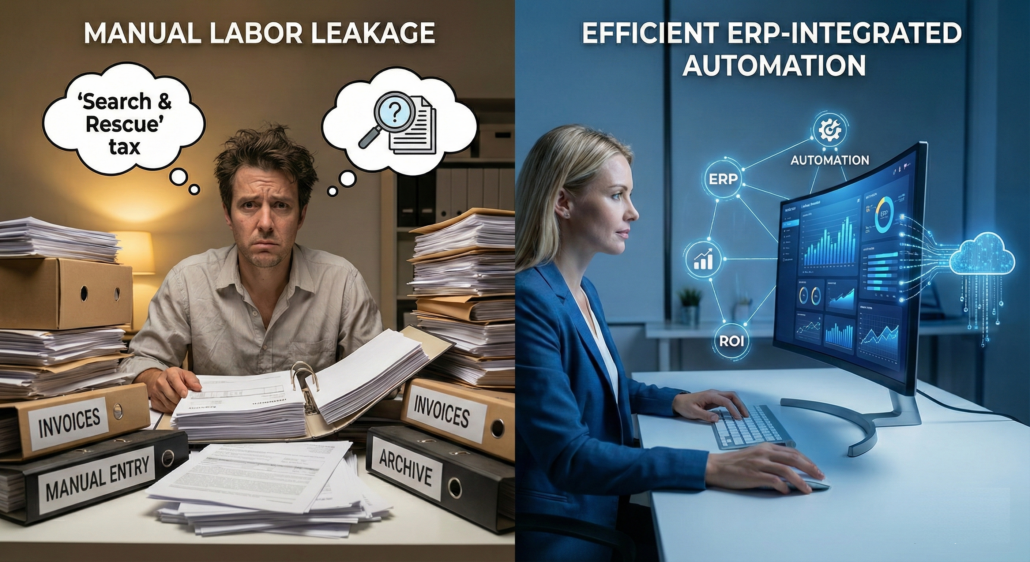
Why Manual AP and Sales Order Processing is Your Biggest Hidden Expense
Imagine leaving the equivalent of 30% of your team’s productive capacity on a warehouse floor or tucked inside a dusty filing cabinet. According to Ardent Partners’ State of ePayables research, that’s precisely where it goes — absorbed by manual Accounts Payable and Sales Order workflows that were never designed to scale. You wouldn’t walk past that lost capacity and do nothing, yet that is exactly what happens every day your team touches a piece of paper.
In an era of tightening belts, the natural instinct for many leaders is to freeze spending. It feels like a safe move. However, for organizations still tethered to manual AP and Sales Order processing, the status quo isn’t a safe harbor — it’s a constant resource drain.
While organizations often delay digital transformation to “save” capital, the cumulative cost of maintaining manual, paper-based workflows far exceeds the investment required for automation. Between labor leakage, missed early-payment discounts, and operational bottlenecks, “waiting” is actually the most expensive decision a leader can make.
The Labor Leakage: Paying Expert Wages for Clerical Tasks
In many offices, talented individuals spend 30% to 40% of their time on what we call “data entry gymnastics” — manually typing invoices, chasing physical signatures for Bills of Lading (BOLs), or re-keying information that already exists in another system. For a deeper look at managing these volumes, see example: Processing High Invoice Volumes with a Small Staff.
Category | Cost per Invoice | Efficiency & Impact |
Manual Processing | $16.00 – $23.00 | High touch, prone to human error, and slow turnaround. |
The Automated Edge | $2.50 – $4.00 | Direct ERP integration; high speed and massive cost reduction. |
“Search & Rescue” Tax | Unquantified “Hidden” Cost | Zero value; time wasted on lost files and audit reconstructions. |
When you automate, you aren’t just buying software — you are buying back your team’s focus so they can prioritize strategic finance work: vendor relationship management, cash flow forecasting, and the analysis that actually moves the business forward. The time allocation in a manual environment looks nothing like the one in an automated environment, and that gap compounds every single day.
The Velocity Gap: How Paper Stalls Your Cash Flow
Paper creates a domino effect that cripples cash flow velocity. Delays in Sales Order processing lead to lagging warehouse picking, which leads to late shipping, which eventually leads to delayed invoicing. Each handoff point where a document sits in an inbox or travels across a building is a moment your cash cycle stalls.
Waiting also means missing out on “free money.” Many businesses simply accept late fees as a cost of doing business, while simultaneously forfeiting early-payment discounts in AP because the paper moves too slowly through approval hierarchies. A 2% early-pay discount may seem small on a single invoice, but across an annual AP volume of $10 million, that’s $200,000 left on the table — every year.
Wood-Mizer, the global manufacturer of portable sawmills and woodworking equipment, confronted this reality directly. Their AP team was buried in manual invoice routing, with approvals bouncing between departments via email and physical sign-off. By implementing ERP-integrated document automation with Mosaic, Wood-Mizer eliminated $51,600 in annual outsourcing costs and compressed their invoice approval cycle, capturing discounts they had previously been unable to act on in time.
West Kentucky Rural Electric Cooperative Corporation (WRECC) faced a similar bottleneck on the operations side. Their paper-based work order and document workflows created delays that rippled into billing and member services. By automating document capture and routing through their existing ERP, WRECC reduced processing time and gave staff the bandwidth to redirect their attention to member-facing work — the kind of work that builds institutional reputation, not just internal throughput.
When was the last time you calculated your average Order-to-Cash cycle? If it’s over 48 hours, you’re losing liquidity that could be working for you.
The Scalability Ceiling: Why You Can’t Grow With Paper
There is a common misconception that you can just “hire another clerk” when the business grows. Scaling via headcount is linear and expensive. Scaling via automation is exponential. Every new employee requires onboarding, training, benefits, and supervision. Every automated workflow, once implemented, scales with your volume at near-zero marginal cost.
At Mosaic, our implementation experts act as a force multiplier, bridging the gap between your existing ERP and document automation. This ensures data flows without human intervention from order entry to shipping confirmation to invoice generation without rebuilding your technology stack from scratch.
What about the “our process is too unique” argument? Complexity is actually the best reason to automate. Manual paper processes survive on tribal knowledge, the institutional memory held by two or three long-tenured employees who know where things go, who needs to sign what, and how exceptions get handled. When one of those people leaves, the process doesn’t just slow down; it breaks. Automation codifies that knowledge into repeatable, auditable workflows that don’t retire embedding your specific business logic directly into ERPs like NetSuite, Microsoft Dynamics, or Sage.
Digital transformation isn’t about replacing people — it’s about replacing the mundane tasks that prevent people from doing great work.
The Compliance & Security Shadow Cost
The true cost of paper often stays hidden until an audit happens — and then it surfaces all at once, in the worst possible context. Consider the difference between searching through physical banker’s boxes for a three-year-old BOL versus pulling a timestamped, searchable digital record with a full approval trail in under sixty seconds. One of those scenarios costs hours and causes stress. The other takes a single search query.
Beyond audit readiness, paper-based systems carry structural security vulnerabilities that digital workflows eliminate:
- Can anyone walk by a desk and see sensitive signature data or vendor payment terms?
- Is there a single point of failure for physical document storage — a filing room, a cabinet, a server room that doubles as storage?
- Can you produce a full approval history for any invoice in under 60 seconds?
A fire, flood, or even a misplaced folder can destroy months of BOL records or proof-of-delivery documents. These aren’t hypothetical risks — they’re the kind of failures that surface in insurance claims, customer disputes, and compliance reviews. A digital archive with role-based access and automatic versioning doesn’t just protect you from disaster; it changes the shape of your audit entirely.
Conclusion: The Lean Path Forward
Waiting doesn’t save money — it just hides the expense in bloated overhead and missed opportunities. The organizations that automate now will have the lean infrastructure to outpace competitors when markets tighten further or demand surges. Those who wait will find themselves with higher per-transaction costs, lower agility, and a workforce spending a third of its time on work a well-configured system could handle instantly.
The question isn’t whether you can afford to automate. Based on the industry data and the results seen by organizations like Wood-Mizer and WRECC, the more precise question is how long you can afford the compounding cost of inaction. True fiscal responsibility isn’t just about cutting costs; it’s about removing the friction that prevents your current resources from reaching their full potential.
If you are looking for ways to tighten the belt effectively, look beyond the ledger at your internal workflows. The efficiency gains are already there — they’re just locked inside processes that were designed for a slower era.
Discover how Mosaic can help you maximize your ERP investment with paperless document workflows. Discover your savings with our experts today!